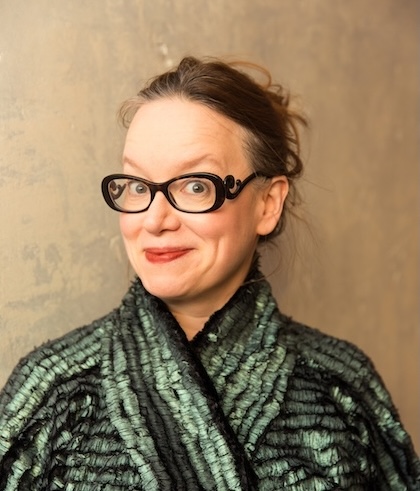
Artist Laura Plybon fell in love with New York City during a college visit, settled down and raised her son in Brooklyn and Long Island, then became an expatriate artist in Madrid. She’s living proof that creativity is the mother of invention and reinvention.
Here are some of her insights, along with her luminescent work:
What Are Days For
1. How would you describe your art?
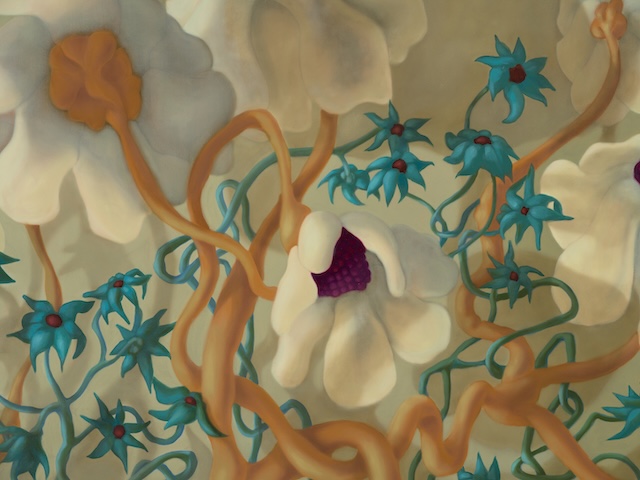
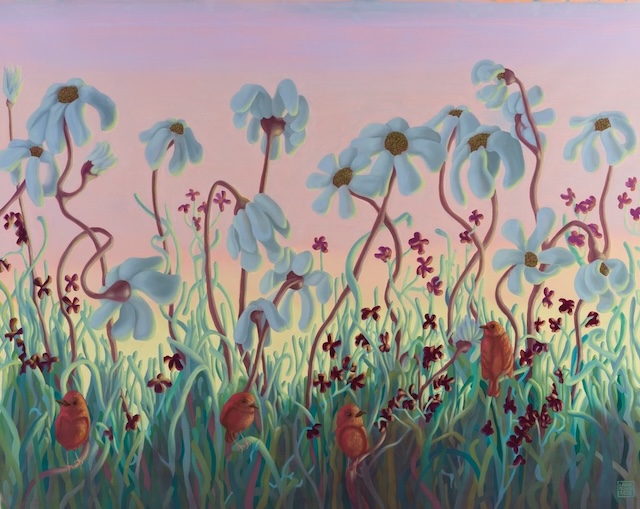
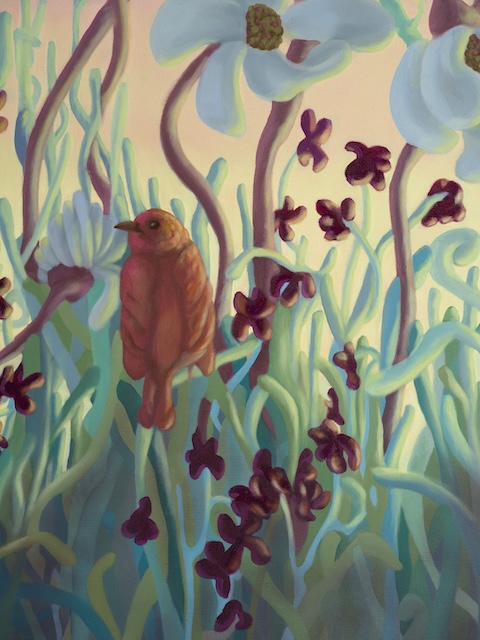
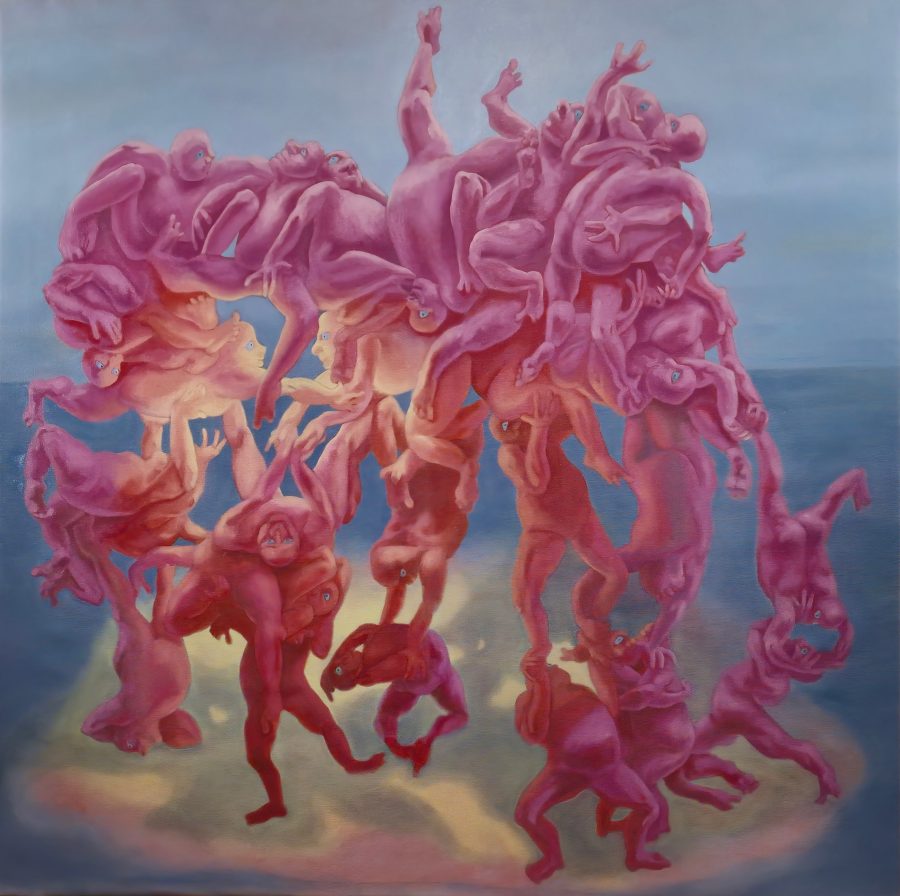
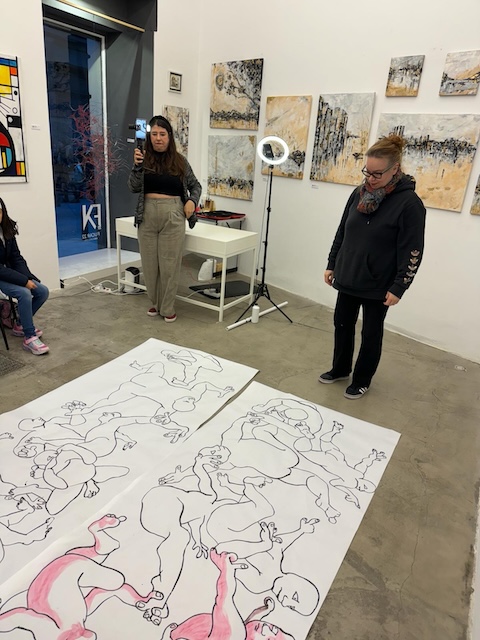
My art is contemporary figurative. For several years I have been painting an imaginary world inhabited by humanoid creatures that exist outside of politics and beyond binaries and some of the laws of physics. The creatures in it are affectionate, playful and emotionally expressive, but entirely platonic. I deliberately remove gender markers and anatomical cues, to challenge how we instinctively assign identity and meaning to bodies, and to address western culture’s discomfort with physical touch. My compositions are sparse, offering contextual clues to suggest a setting but not a complete story. This invites viewers to project their own interpretations and narratives onto the scene, co-creating meaning in a world free from familiar constraints. In the last 12 months, I have begun adding animals and flora to this world, in a new series called “The Garden” that contextualizes my menagerie and humans in separate realms existing in different forms of time (circular and linear). It explores how animals – who were allowed to remain in the Garden of Eden living in circular time – regard humans that are stuck outside the garden walls in our linear time existence.
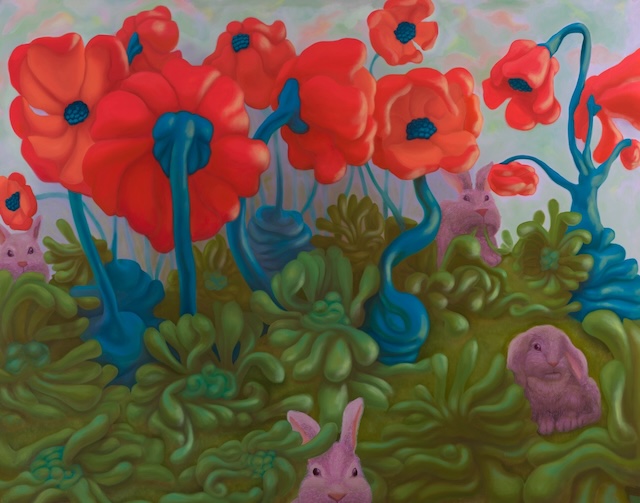
Rabbits After Rain
2. Where are you based, and does your location have any influence on your art?
I am primarily based in Madrid, Spain, and my location definitely influences my art. From a practical standpoint, here I am able to afford a much larger studio space, and more time to immerse myself in my work. But the influence of Spain is shown in “The Garden” series…I feel that humans get to inhabit circular time, in Spain. Each day has a repeated structure, and people really like to adhere to it. The Spanish eat like Hobbits, there are actually 5 mealtimes (breakfast, second breakfast, lunch, afternoon snack, dinner) and in between there is work, time spent with family, time resting, time walking. Every day. Very different from NYC which is the apex of linear time.
3. Did you know you wanted to be an artist as a child, and did you go to art school? If not, how did your art path develop?
Yes, I did know. As a small child I used to go around with a paintbrush and run it along trees and leaves and flowers pretending I was painting them. I did attend art school, but ultimately dropped out from the BFA program at Carnegie Mellon after visiting NYC for the first time on a school break. I didn’t want to be anywhere else. That led to 30 years in NYC with art taking a back seat to supporting myself and eventually my family as a software engineer. In 2014 I resumed a daily drawing practice that snowballed until, in 2021, I realized I needed a strategy to pivot back to art. I accepted a work assignment in Madrid with that goal in mind, and after several years here, was able to make it a reality.
So Small
4. Did anyone else greatly influence your art – for example, a relative, another artist, a particular art era or movement, or a muse?
Like most artists, the DNA of artist predecessors can be seen in my work, if you squint. The biggest influences you can see in mine are Maurice Sendak, R. Crumb, and Kenny Scharf. I used to spend hours as a kid staring at Maurice Sendak’s amazing ink drawings. I watch the documentary “Crumb” at least once a year. Scharf’s piece “Junglematic” is in the permanent collection of the Thyssen-Bornemisza museum here in Madrid; I visit it regularly and am excited that the museum has a big Scharf exhibition scheduled for the fall!
So Small Detail
5. What is your perspective on museums and galleries in 2026? Can they be improved, and if so, how? Do you have a favorite museum?
I spent my days in the business world for decades, so my perspective is informed by that. Owning a gallery is a tough business. Taking on new artists is hiring, and hiring is really hard in every business. Galleries take bets on people in a low margin business where data is limited and credentials don’t provide as much security as an e.g. ivy league law degree. Recruiting seems to come primarily from BFA/MFA programs, word of mouth, and Instagram, so if I could suggest an improvement it would be more open calls and/or calls for proposals.
As for museums – maybe a few less big acquisitions to free funding for a bit more opportunity for visibility of less established artists? Institutional visibility is a big challenge for artists to get to mid-career level.
6. What is your perspective on Artificial Intelligence and whether or not it can be used as a tool for artists. If it can be, how would it be used?
Across the board, AI use should be limited until energy and resource consumption can be more efficient, full stop. Beyond that, I don’t think AI should be trained on existing art works unless there is a way to ensure it will be used only for educational/informational purposes, and not for AI generation of derivative works. The valid use cases for artists that I see are instructional. Very occasionally, I use it to deepen my application of color theory. For example, I will have a specific palette in play and a specific outcome I want to achieve with a glaze, and I can ask which pigments will best achieve that outcome, and get useful suggestions. But I have done this only a few times. I feel a lot of guilt when using AI due to the impact of data-centers on communities and the environment.
Field Foundation I
7. Knowing it’s impossible to choose a favorite piece (it’s like having to choose a favorite child), what is one of your pieces that you absolutely love?
Field Foundation I. This was the first time I felt like I was really painting, and able to take a drawing I loved and turn into a specific, different vision with color and light. It just flowed out of me.
8. Do you have a favorite artist or one you find inspiring?
Philip Guston, specifically his figurative work from 1970 onwards. I absolutely love those paintings and drawings, but also his journey to them, and how he talked about his creative process.
9. How do you see your work evolving? Do you have any specific goals, or do you follow your inspiration where it leads you?
I am definitely going to incorporate both animation and sculpture into my practice, it’s just a question of time. I am still obsessively painting but when my current series are complete I have projects for both animation and sculpture that I want to engage with. Drawing is a constant, I am literally constantly drawing, and that seeds the future work. My drawings become the paintings/sculptures/animations and while I’m creating those, I’m doing more drawings of the next things.
10. If you weren’t an artist, what would you be instead?
An anxious and agitated person, for sure! But professionally, if you mean if I can’t be a visual artist: I would try to be a writer. If that’s off the table too, I would not go back to software…I would open a book store. Or maybe offer the behavioral hiring skills I honed as a hiring engineering manager to a gallery?
11. What is the tough thing about being an artist, and what is the great aspect of it?
The tough thing is starting a small business where both startup and production costs are high, margins are low to zero for a long time, and you have to make a lot of bad work to get the good work yet somehow sustain confidence to continue. You have to burn through your art supplies, yet not live in fear of being unable to afford more.
12. What is your schedule as an artist… Do you work by day or night, or both, and do you work as long as you please or do you slate particular time frames for creating?
Decades of a day job in the corporate world have molded me to the industrial circadian rhythm. I like slow mornings, so I start late morning and continue until I feel done, which is sometimes late afternoon, sometimes early evening. But when I’m done working in the evening, I then spend hours drawing while listening to the TV, which I don’t consider to be work. For years it was a treat to get to immerse myself in drawing, and that feeling hasn’t changed.
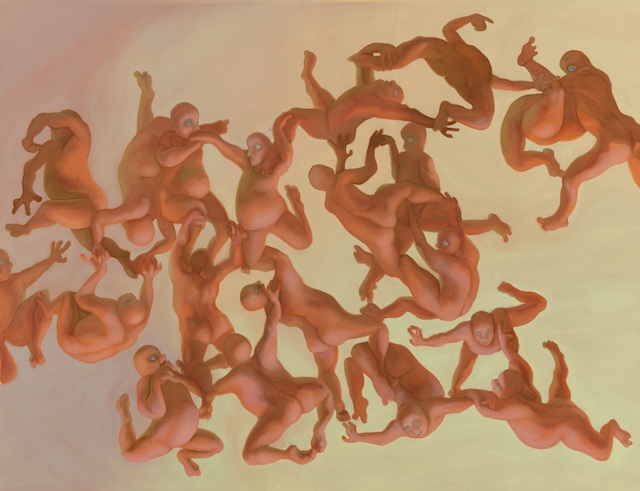
Cloud Formation
13. How do you market and promote your artwork or portfolio website?
Good question! At the moment, I am not marketing or promoting aggressively, I’m focused on building my professional network (including peers, curators, collectors, suppliers etc.) while I create a lot of work. Word of mouth has placed a surprising number of paintings in collections. Last September I participated in the Artist360 Art Fair during Madrid Art Weekend, which was a baby step into promotion. Next month my studio is participating in the ARCO Madrid (biggest annual art fair in Spain) Carabanchel open studio walking tour, which is another step that I am excited about. I would like to do a public mural of my Doodlezwerg.
14. Do you have any exciting, heartening, disheartening, or alarming customer tales?
I am an exhibiting member of the National Arts Club, and there is an Exhibiting Member exhibition every year in May. Last year, at the opening, my piece (Field Formation I) sold in the first 30 minutes – a very validating moment for me! As an added happiness, my son was standing right next to me when the buyer cut through the crowd walking towards us, pointing at my piece and loudly asking “ARE YOU THE ARTIST WHO PAINTED THAT?”. It felt great to share the moment with my son.
15. Is it sometimes tough to part with a piece you created because you put so much of yourself in it?
Yes. They are like my animal spirit guides. When they leave the studio their energy goes with them to their new home.
16. Do you gift loved ones and friends with art, or keep those realms separate and view it strictly as a business?
Yes, I give drawings away all the time. I am a strong believer in the connection between generosity and karma.
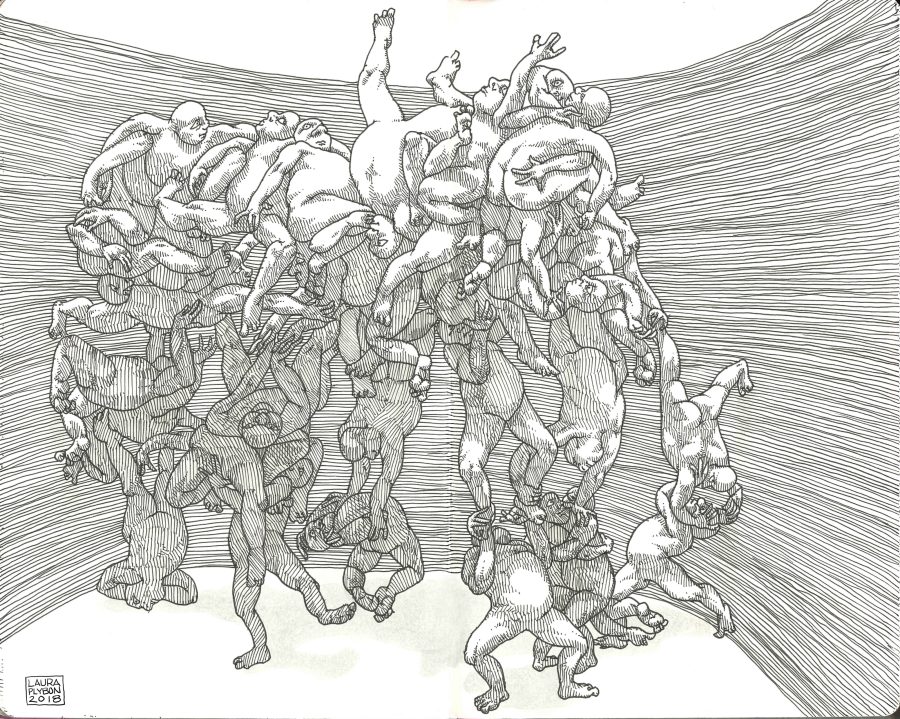
In Church
17. What do you want to tell readers about the art world?
I’m at the beginning of my understanding of the art world, so I don’t have any major insights yet. But I do see it’s just like any other business domain – the people who are very engaged, immersed and energized by it are the ones who show up and get the most visibility and opportunity. During my decades of software engineering I was grateful to have a mentally stimulating way to earn rent money, but was never passionate about it, so career growth never felt organic. The art world is a much more natural fit for me, and I’m enjoying becoming a part of it.
18. How did you choose the particular type of art you create over other types of art? Do you go through phases where you’ll try different mediums, sizes, styles of art or do you deep dive into the area you want to fully fathom?
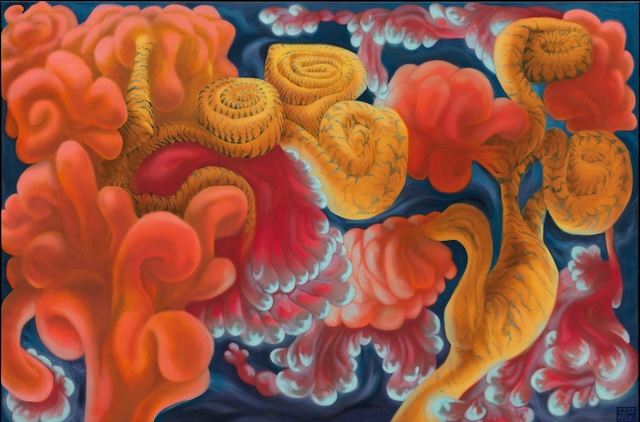
Art is an artifact of process, and process is the whole point. What pulls me in and gets me working is the desire to make marks, the desire to spread paint, the desire to glaze and create a glow, the alchemy. My choice of materials and mediums has always been through trying new things to problem solve – how can I achieve a desired effect, can I find a more pleasant texture, is there something that gives me brighter color, etc. This led me from alcohol markers to acrylic paints, to oil paints, with side quests through water colors, pastels (both kinds), color pencils (all kinds), inks (every kind I can find). And more to come. I have my eye on linocuts for my next exploration.
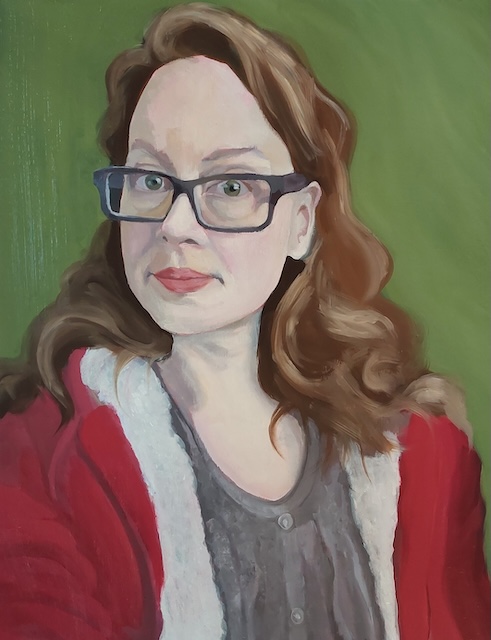
Self-portrait
19. Where can readers purchase your art?
Readers can see my art on my website lauraplybon.com, and Instagram at @lauraplybonart. If there is interest in a specific piece or a commission, they can reach out to lauraplybon.art@gmail.com
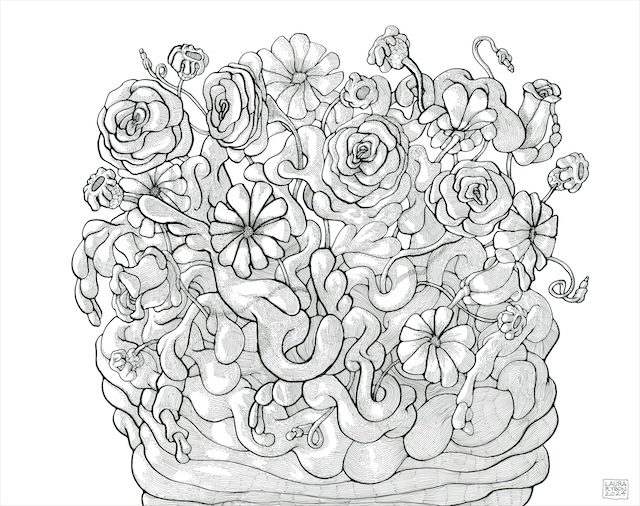
Flesh Flowers
20. Do you have any insightful tips for emerging artists?
Don’t feel like you can’t progress because you don’t have a studio space or money for a lot of supplies. You are better off with cheap sketchbooks (or polymer clay etc.) that you can afford and can burn through without caution than you are with a big space and barely-affordable minimal supplies and total fear of using them the wrong way without being able to sell the proceeds. You need to make a lot of work to get into the flow, disengage from outcome and discover what you love to make. Engage as much as possible with the art community, that is where you find peers with shared values – critical for your growth and day to day happiness.
Read our other Meet The Artist interviews HERE.