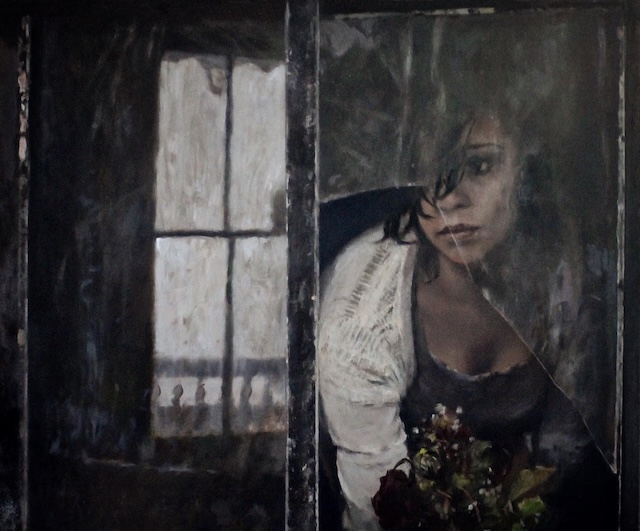
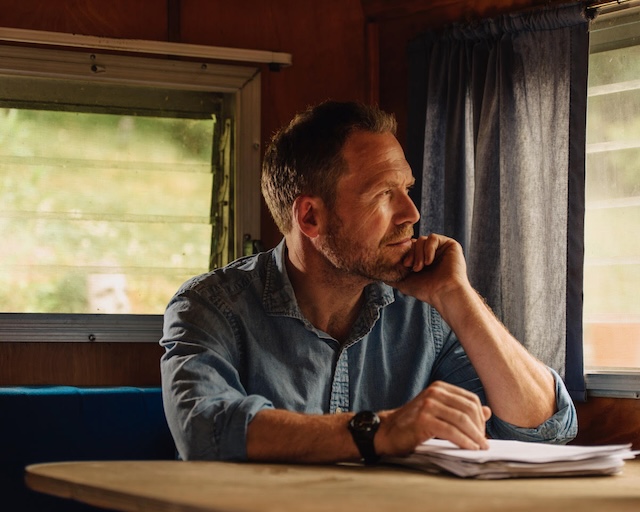
Julyan Davis is the quintessential Renaissance man as a celebrated painter, an award-winning author, and a voracious reader. Based in Asheville, NC, he was raised in Britain and has been steeped in America’s Southern folklore and culture for decades, which is reflected in his paintings and writing. The subject of four documentaries, five podcasts, and many dozens of feature articles, his work is exhibited internationally, and is found in numerous public and private collections. Recent acquisitions include the Gibbes Museum in Charleston, the Greenville County Museum of Art (South Carolina), the Morris Museum (Augusta, GA), the Duke Endowment and the North Carolina Governor’s Mansion.
What’s more, Davis’s debut novel ‘A History of Saints’ was a 2022 semifinalist for the Thurber Prize. We fashioned these 20 questions for him to help guide emerging artists who are following in his path, though each artist’s path is unique.
1. How would you describe your art?
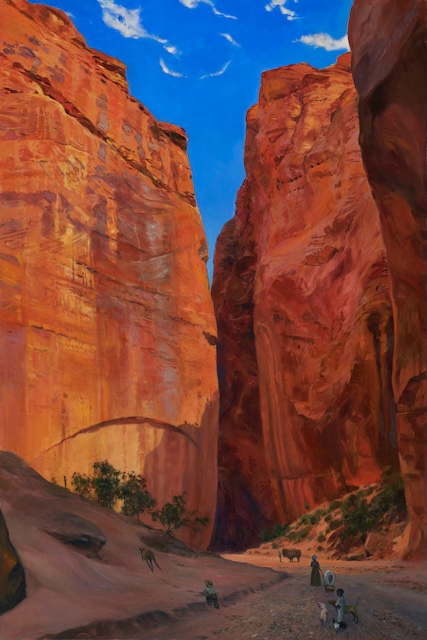
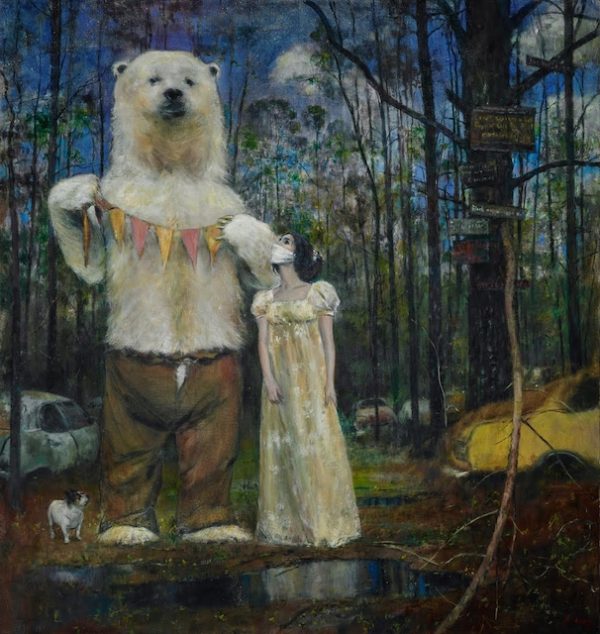
I generally paint in oils. My work is landscape-based, representational, but with a lot of unusual (for a painter) forays into American legends and forgotten history.
2. Where are you based, and does your location have any influence on your art?
I live and work in Asheville, NC. The folklore of the Appalachians — the stories and music, their Scottish origins, are a big influence, connecting me back to Britain.
3. Did you know you wanted to be an artist as a child, and did you go to art school? If not, how did your art path develop?
I was very lucky in always knowing I would be an artist from the earliest age. I went to art school in London.
4. Did anyone else greatly influence your art – for example, a relative, another artist, a particular art era or movement, or a muse?
My family were very supportive of my being an artist. My father was an author, and there are Victorian painters in the family history.
5. What is your perspective on museums and galleries in 2026? Can they be improved, and if so, how? Do you have a favorite museum?
I understand galleries and museums will have to keep up with the times — there will be a lot of AI-created, immersive work ahead — but they should also strive to educate an increasingly digitally-minded public with what art has been, and how it has been made in the past. It’s a challenge for them, for sure.
6. What is your perspective on Artificial Intelligence and whether or not it can be used as a tool for artists. If it can be, how would it be used?
AI will change art. There’s no doubt of that. I see a lot of younger artists eager to build a presence in the world and on social media, and AI will certainly be used by them to speed up that process. I would imagine the idea of creating something precisely because it is a challenge will continue, but unfortunately, I see that as a diminishing choice.
7. Knowing it’s impossible to choose a favorite piece (it’s like having to choose a favorite child), what is one of your pieces that you absolutely love?
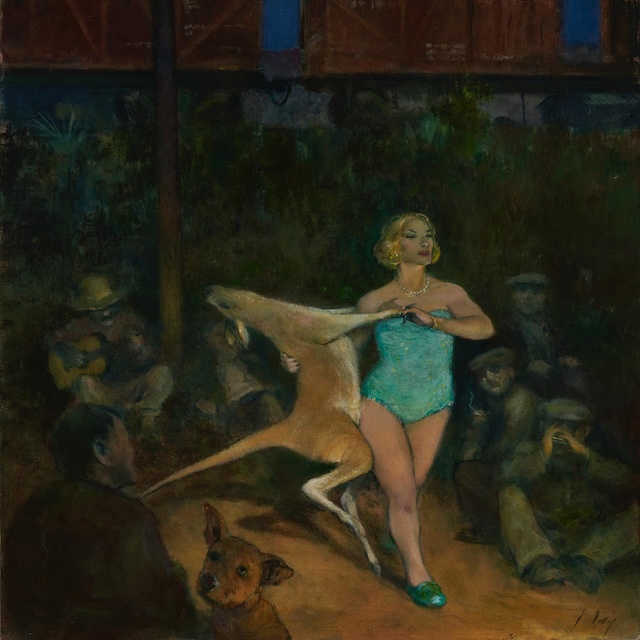
I have a series called “American Ghosts.” It is sort of a satirical novel in paint, part Mark Twain, part Wizard of Oz in feel. It follows the adventures of three ghosts: Betsy, part of the Gold Rush; Belle, the Confederate militiawoman; and Nancy, a circus strongwoman from the Dustbowl. Their adventures together take them across both America and American history. Many of those paintings make me smile but I think my favorite is Nancy dancing with the boxing kangaroo she has rescued from the circus.
8. Do you have a favorite artist or one you find inspiring?
There are so many of course! But Bruegel is a particular favorite these days.
9. How do you see your work evolving? Do you have any specific goals, or do you follow your inspiration where it leads you?
I will continue to tell stories in paint. This does not jive brilliantly with commercial galleries, but I will make the art for non-profit opportunities. My dream would be to have the money to become a true outsider artist — to own a place big enough to hang all those narrative works, then just sit on the porch and chat to visitors.
10. If you weren’t an artist, what would you be instead?
A writer!
11. What is the toughest thing about being an artist, and what is the greatest aspect of it?
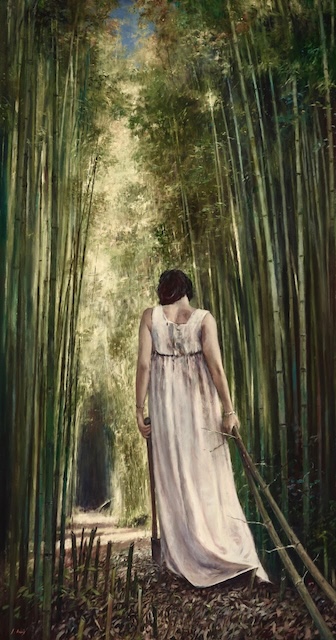
For me, the hard thing about being an artist is finding the balance between work that challenges me and work that is still appealing to the public. To be honest, I have from the first divided these two. I paint work that hones my craft and is appealing to the public, then spend the rest of the day doing work that I do not expect people to buy, but that allows me to explore. This is the work that tours museums and then comes back to me. The great aspect of being an artist? Such freedom.
12. What is your schedule as an artist… Do you work by day or night, or both, and do you work as long as you please or do you slate particular time frames for creating?
I work pretty regular hours, Monday through Friday, and maybe a few hours across the weekend. I only work in the day.
13. How do you market and promote your artwork or portfolio website?
I tend to leave that to the galleries that represent me.
14. Do you have any exciting, heartening, disheartening, or alarming customer tales?
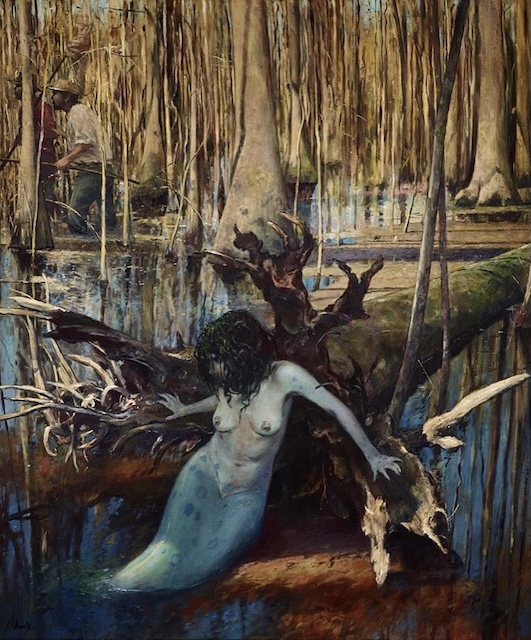
A reclusive mother and daughter have collected many works of mine over the years. The paintings are all in one room, the breakfast room, and they regularly discuss my paintings. They know my body of work far better than I do. I try to remind myself every day that such people exist, because the retail side of being an artist can so easily make you forget what is miraculous about the relationship between the collector and the artist.
15. Is it sometimes tough to part with a piece you created because you put so much of yourself in it?
As I mentioned, I have found a way two separate much of my work into museum work and commercial work, but sometimes a special piece slips out of my hands!
16. Do you gift loved ones and friends with art, or keep those realms separate and view it strictly as a business?
I certainly have. I wonder if the relatives of artists should form a support group? To kvetch about all the dust-collecting paintings covering their walls!
17. What do you want to tell readers about the art world?
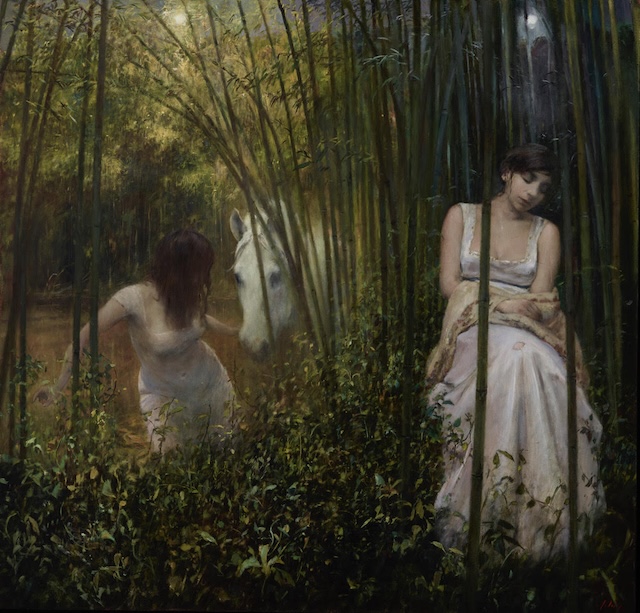
Well, there are varied art worlds, but regarding the art world of the Biennales, the Whitney etc. I would say this. More than a century ago, the Art World leaned towards making art about art. One Ism after the next. Recently it has become more polemical, but it is still a distant, foreign language to the public. The most elite art world is not providing the consolation art can provide for the human experience. It should be less about art and more about life.
18. How did you choose the particular type of art you create over other types of art? Do you go through phases where you’ll try different mediums, sizes, styles of art or do you deep dive into the area you want to fully fathom?
Great question. I settled for a more traditional way of painting because I love paint but I also need a fairly high level of detail for people to be able to read every part of each painting easily. I pick a lot of subjects that are rarely painted so I can’t be too expressionistic.
19. Where can readers purchase your art?
I just sell through my galleries. They will come up quickly in a search if you enter my name, Julyan Davis. (His website is here).
20. Do you have any insightful tips for emerging artists?
Be painterly. Be human. Make your journey who you are, not any particular style or subject. Find a community (in the real world). Hold fast.