
Presented by BFA Visual & Critical Studies at the School of Visual Arts, Evening Star is an art exhibition with an immersive, socially-engaged wellness component rooted in spiritual ecology and feminine folk wisdom. Invoking shared cultural memory, Evening Star stirs the colloquial imaginary around themes of folk and neo-folk practices, archetypal dreaming, stars, magic, and the wisdom of ancestors, centering female energy as limitless, open-ended creative potential.
The term ‘Evening Star’ refers to the cyclical movement of Venus in the sky, which situates her as either a morning (visible at dawn) or evening (visible at dusk) star. The hottest and brightest planet in our solar system, Venus is associated with feminine energy. Her conjunctions with the Sun form a five-pointed star, or, when inverted, a pentagram. Venus’s intersections with the Earth form a sacred heart and, over several cycles, a flower. Before modern sky watchers adopted the Roman name Venus for this heavenly body (Aphrodite for the Greeks), the ancient Babylonians called it the ‘Star of Ishtar.’ Called Inanna by the Mesopotamians, one of the earliest recorded Goddesses, her true multifaceted form is a promiscuous and warlike Goddess of love, lust, music, and war. Inanna’s fearsome war cries freeze her enemies’ blood, but we often hear only of her underworld descent and rape. Inanna is stripped down. Entering hell completely naked, she is hung from a hook and unable to escape – a myth qualifying planet Venus’ morning from evening phase. Venus as Morning Star is a Warrior, Venus as Evening Star, a Goddess of Love.
While ancient Mayans looked to planet Venus when deciding to go to war, Evening Star centers the softer, more intuitive and empathic ‘Lover’ side of the multifaceted and ancient archetype – while not denying the revolutionary potency of her eternal battle cry. With ‘folk’ traditions evidenced in hybrid format amongst selected artists’ work (storytelling, herbalism, somatic energy healing, music and dance cultures, matrifocal astrology, circle work, whirling) – Evening Star – like planet Venus from which it takes its name, names a cycle, an endless continuum. As a gathering of human currency – an opportunity to raise energy and invoke the unseen realms – this is the veritable ‘food, source and sustenance’ noted in the classical definition of ‘exhibition.’
Activating the SVA Flatiron Project space in dynamic ways, February 22 – March 19, participating artists include Damali Abrams, Fanny Pérez, Marcia Jones, Adehla Lee, Elisa Garcia de la Huerta, Bri Frei, Nancy Azara, Kay Turner, Jodie Lyn-kee-chow, Qinza Najm, Fran Flaherty, King Adonnis & Moon Lab.
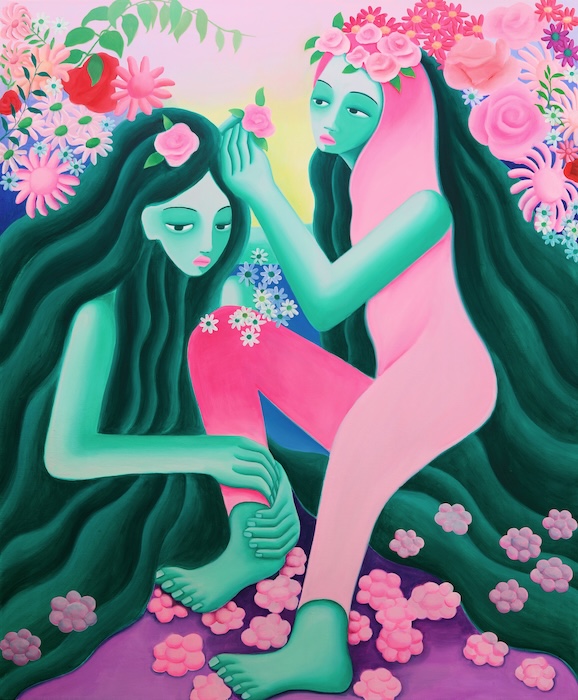
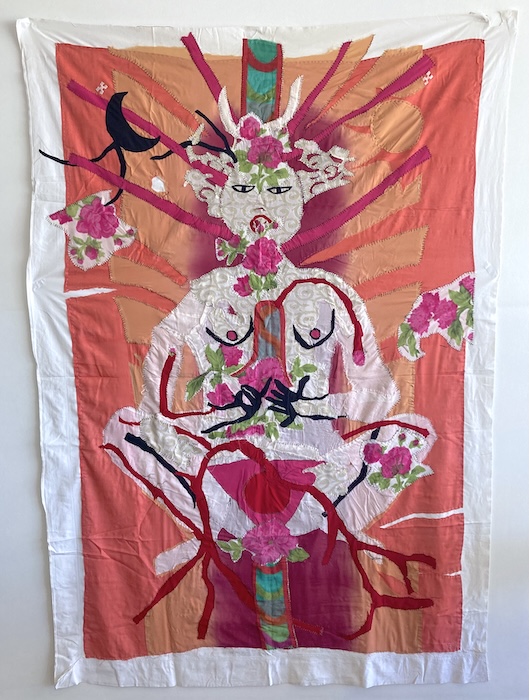
SVA MFA ’11 alumni painter Adehla Lee presents two new figurative paintings celebrating the divine feminine lineage of her family back home in South Korea. In colorful homage to her Grandmother’s shamanic healing practice, Lee’s renderings of young women amidst ornamented floral backdrops recall how, despite laws that forced magical healers underground in Korea throughout the artist’s childhood, her Grandmother’s legacy still lights the threshold where inherited cultural wisdom meets natural law. Queercore Chilean feminist no-genre artist and Ayurvedic practitioner (SVA MFA ’11), Elisa Garcia de la Huerta’s textiles and soundscapes are informed by on-body research at the intersection of tantra and techno.
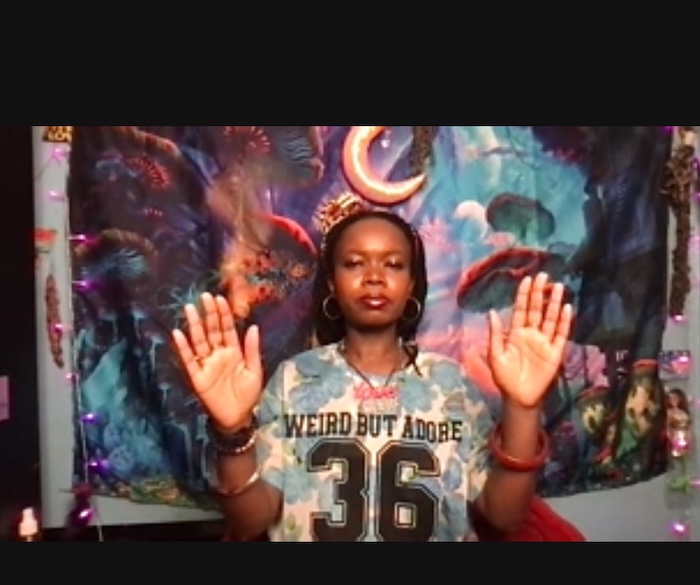
Multidisciplinary healing artist Damali Abrams explores Black Utopia through the lens of pop culture and Afro-Caribbean syncretic religions. Her Black Mermaid collages and self-help rituals splice folk wisdom with Afro-futurist cult classics. For the SVA exhibition, Abrams will show “Quarantine Reiki for When You Are Feeling Sluggish and Have No Energy,” a distance reiki healing session captured on film the artist originally released in 2020 at the onset of the pandemic.
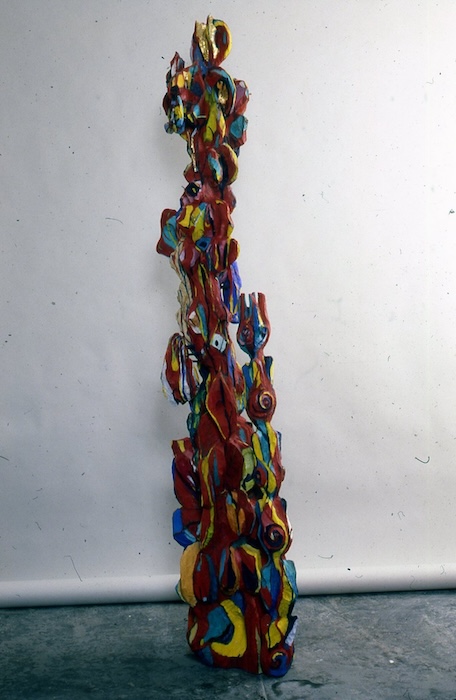
Gender-non-conforming Italian American artist Nancy Azara’s sculptures and installations of carved and painted wood are towering, elevated altars to uncompromising female divinity. After the artist passed in 2024, a younger generation of young femmes following in her footsteps continues to venerate her groundbreaking work as a founding member of NYFAI, a feminist artist institution known for its groundbreaking consciousness-raising practices in the 80s. Evening Star will include one of Nancy’s older and rarer sculpture works, a full-size totem-like stick, made from oil, tempera, and gold leaf on carved and bleached wood, titled Sun Goddess (1983).
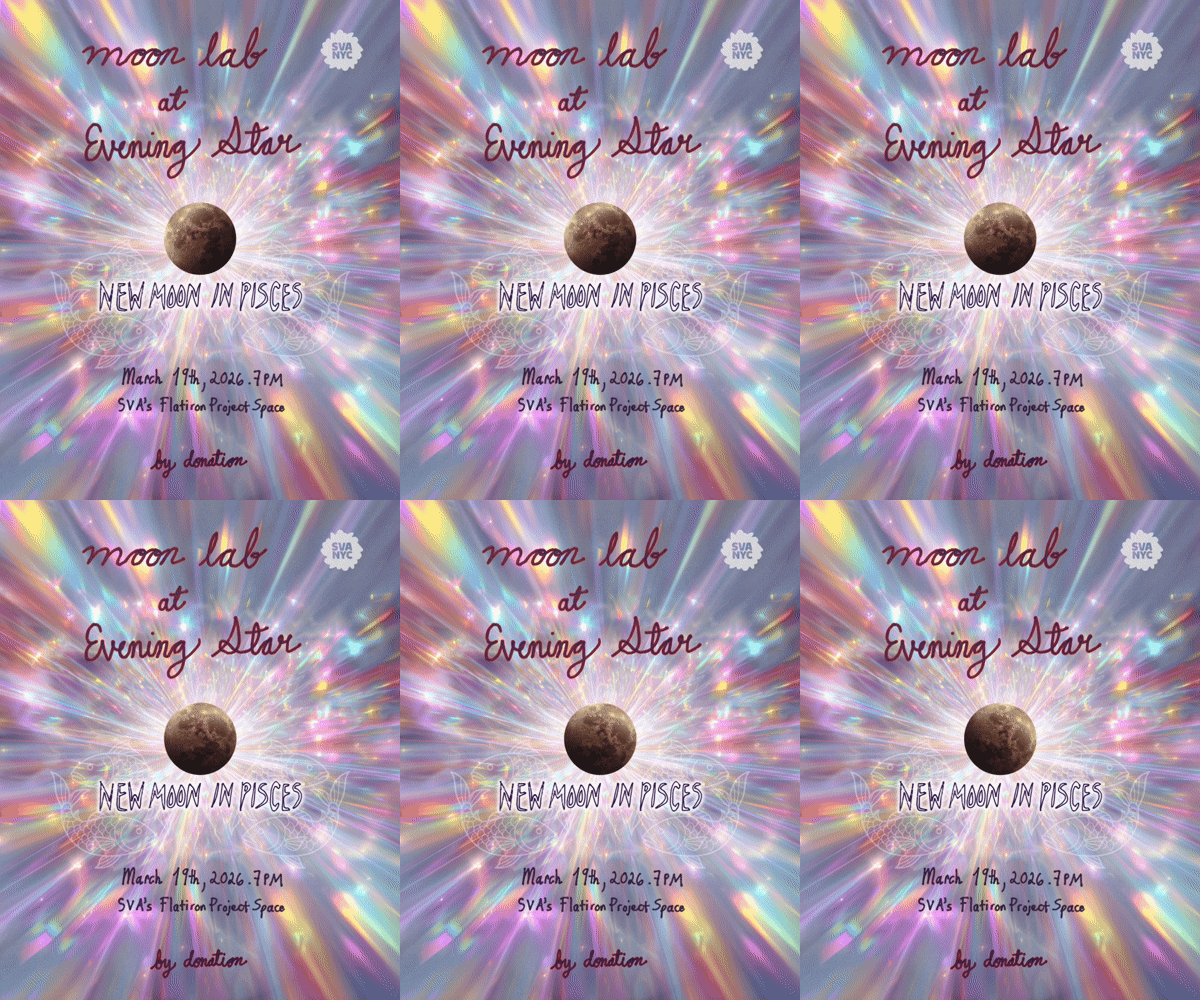
A celebrated fixture of New York City’s sacred arts community, Fanny Pérez explores healing through trance and ecstasy. Modern witch and whirler, Pérez is known for her hybrid performance practice, incorporating Sufi whirling and other trance-based modalities. She’s also a co-facilitator of Moon Lab with Juliet Rania. Moon Lab’s ritual gathering for the New Moon in Pisces, March 19th, doubles as a closing party for the exhibition. For the opening reception of Evening Star, Fanny will perform in collaboration with her sister Clau Pérez, a digital artist whose AI-driven new media work transforms technology into ceremony—crafting experiences where geometry, code, and emotion converge into states of transcendence and love.
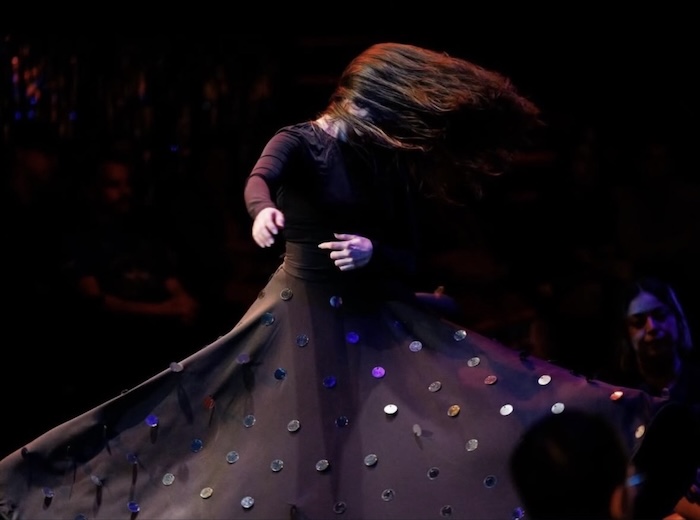
Fanny Pérez, performance during Guadalupe Maravilla’s “ICE AGE limpia / Ceremony at RedCat Los Angeles (2025) photo @angeloriggi
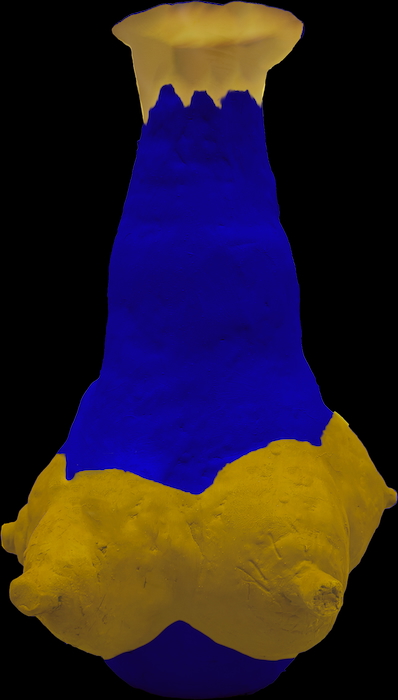
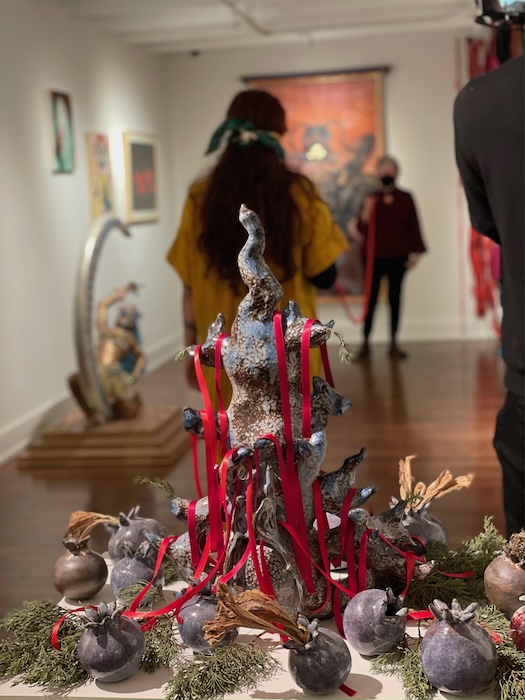
Fran Flaherty, founder of Anthropology of Motherhood, presents two petite sculptures inspired by the Filipino Masuso pot. Known for her extensive sculptural work with human breast milk encased in resin and organizing with the Not-White Collective, Flaherty’s recent exploration involves research-inspired renderings of an enigmatic, ancient earthenware vessel named for the Tagalog word suso, meaning breast. Featuring multiple breast-like protrusions, typically seven, the Masuso pots’ exact cultural origins and purpose remain unknown. Believed to be used in sacred rituals symbolizing fertility and nourishment, several pieces are included in the National Museum of the Philippines’ permanent collection.
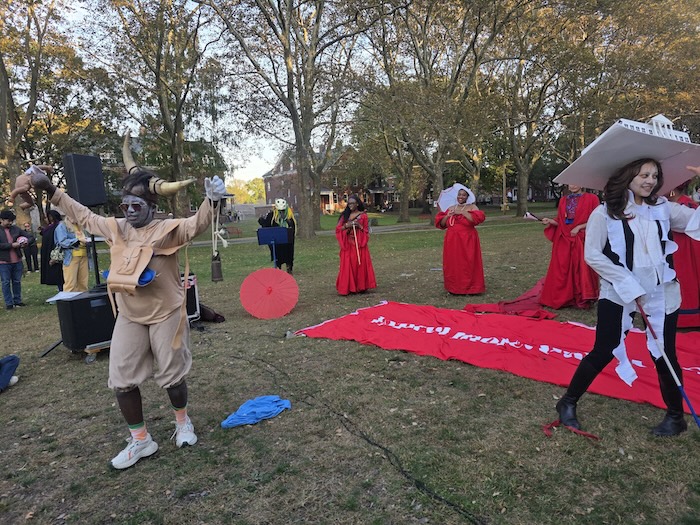
Jodie Lyn-Kee-Chow is an American interdisciplinary artist and SVA faculty member best known for her work in performance art. For the Evening Star exhibition, Lyn-Kee-Chow is showcasing collected video footage and memorabilia from her ongoing work Junkanooaacome. Intended to decolonize and raise awareness of NYC’s historic spaces and monuments still bearing names of slave masters, Junkanoo is a centuries-old ritual art form based on celebrating freedom brought to life by Jodie in a series of interdisciplinary and interactive workshops, performances and other media. Traditionally, a pre-abolition satirical masquerade and decolonization satirical ceremony confronting slave-masters and practiced during Christmas in parts of the Caribbean, Junkanoo celebrations typically involve parading with ornate costumes including grand hats replicating houseboat mansions, while others entail colorful characters engaging in miming, drumming and dancing. An age-old performance of freedom, Junkanoo is named in honor of the 18th-century Akan warrior, Jon Konny, who defended his native Prince’s Town (present-day Ghana) from the Dutch colonizers for over twenty years.
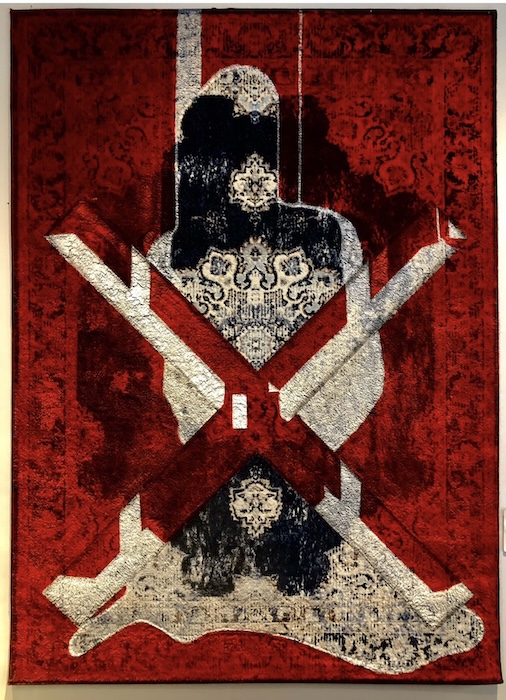
Qinza Najm, a Pakistani-American interdisciplinary artist whose work investigates the intersections of identity, gender, and power through painting, installation, and performance, also holds a Ph.D. in Psychology. Bringing both analytical depth and visceral urgency to her practice, during the exhibition at SVA, Qinza will present new oil and acrylic works on canvas and reclaimed carpet revolving around the timely theme of “Reclaiming Space” for female-identified folks. Bridging Eastern ornamentation with feminist critique, Najm’s practice navigates the emotional residue of displacement and the quiet radicalism of reclaiming space—bodily, cultural, and psychological.
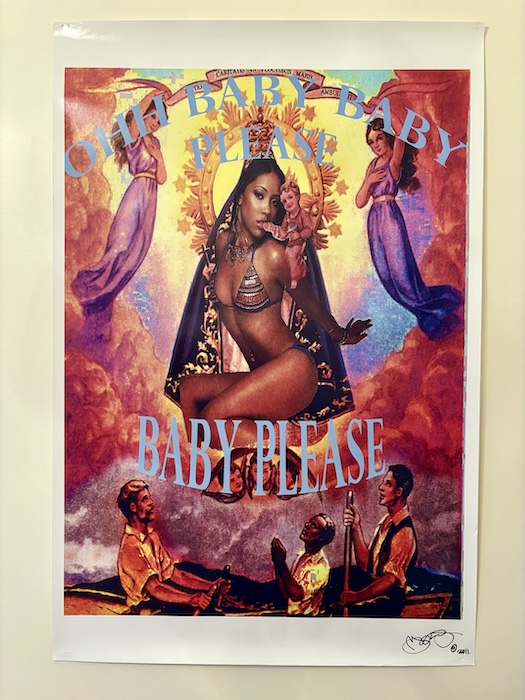
Also included in the exhibition is Displaced Oshun Theory #5, a collage made by artist Marcia Jones. Drawing on a larger body of work from the early 2000s, Jones’ series invokes the Yoruba Goddess of Love and Intimacy, Oshun, as a “displaced” figure within popular culture. Brought to life in a series of works on paper, Jones correlates the way rappers worship the female body in strip clubs to the way men of the Vodun religion pray at the foot of an altar. Despite the distorted lens through which we often view popular music rooted in African diasporic culture here in the West, within a more Afrocentric cosmology, sexuality, trance, and the healing use of vital sexual energy cohere in dance as sacred medicine. “The way they would put money down – call me twisted – but, they made it rain on these mothafuckin altars,” reflected the artist in a 2013 artist talk posted on MEKtext Network.
Also in the realm of the Love Goddess, folklorist Kay Turner, freshly back from touring Austin for the 40th anniversary of her lesbian punk rock band Girls in the Nose, joins interdisciplinary artist Elizabeth Insogna for the next iteration of their ongoing collaborative practice. Following ‘Hekate’s Grove,’ an exhibition they presented at Five Miles gallery in 2022, Turner and Insogna will perform “Aphrodite’s Mirror/Hekate’s Reflection,” a participatory ritual exploring and embodying the sky-earth relationship between Aphrodite (Venus) and Hekate for the opening reception of Evening Star on February 26th. An interdisciplinary artist and educator based in Brooklyn, NY, Elizabeth Insogna’s ceramic sculptures, drawings, and ritual performances explore the divine feminine through a queer, feminist and occult lens.
Overall, works in the Evening Star exhibition reorient the viewer’s focus to what is less visible, those oral histories, burned books, and hidden mysteries, inducing the powers of the ‘Dark Feminine’ and what has been culturally disavowed under white supremacist imperialist patriarchy. Evening Star invites the resurgence of the ancient wisdom keepers with a focus on indigenous ways of caring for the planet and situates artists as divine architects of the future.
As a catalyst for cultural growth, stimulating new interactions between students, professional artists, creative communities, and the public, SVA Flat Iron Project Space feels like a natural home for the auspicious group of radical creatives coming together around an art exhibition centering female energy. A pivotal moment for the world’s budding understanding of intersectional feminism – from emerging visions of a queer cosmos to the radical necessity to make it safe to live in a non-male, non-white, non-cis body again – these artists are reclaiming space and authoring their own narratives.
Deemed irrational by those set on maintaining hegemony, for those of us fighting for freedom from an oppressive and fascist for-profit system, the moment of crisis presents opportunity. With grief, we acknowledge the many body-based issues empaths and creative types are dealing with, heightened by feelings of isolation and depression. Exacerbated by continual confrontation with corrupt systems, state violence and lethal lies. Solidarity requires a felt connection displaced by techno-capitalism. In this vein, our ongoing work of ‘remembering’ demands a high level of social-emotional accountability – centering embodied wisdom, intersectional and transnational feminism, healing, matrifocal storytelling, and somatic practice as necessary and essential for the creative class.
Evening Star is on view February 22 – March 19, 2026
Curated by Katie Cercone
School of Visual Arts Flatiron Project Space
133-141 W 21st St, New York, NY 10011
The gallery is open Monday through Sunday, 9am-6pm, and is fully accessible by wheelchair.
Opening Reception Thursday, Feb 26th 6:00 – 8:00pm
Featuring live performances by Fanny Pérez, Bri Frei & Kay Turner with special guest Elizabeth Insogna. Psychic readings by King Adonnis
Additional Programming
Moon Lab Thursday, March 19th 6-8pm
Moon Lab is a co-created ritual space for femmes and allies co-led by Fanny Pérez and Juliet Rania, with astro-insights by Midheaven Or Nah. Come gather to meditate on the New Moon in Pisces with led movement, meditation, astro-insights and circle work.
Suggested: Wear comfortable clothing and bring a water bottle and a journal.
R.S.V.P. for Moon Lab HERE